
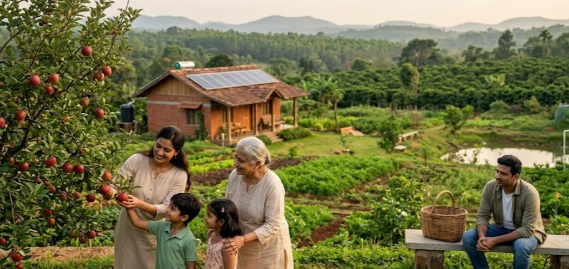
For the majority of Nature N Me‘s investors, Coorg farmland is a financial investment and a periodic retreat destination — not a primary residence or a place where children go to school. But a growing segment of investors are considering more extended engagement with their Coorg property — spending months per year rather than weeks, working remotely from the estate, or in some cases exploring whether Coorg could eventually become a primary residence in retirement or semi-retirement.
For families with school-age children who are considering extended periods in Coorg, understanding the educational landscape is a genuine practical consideration.
Kodagu’s School Infrastructure
Madikeri, as Kodagu’s district headquarters, has the most developed educational infrastructure in the region. The district has a range of schools from government Kannada-medium primary schools through to English-medium private schools that serve both the local population and the children of estate families.
Among the English-medium school options in and around Madikeri are schools affiliated with Karnataka state board curriculum, some with CBSE affiliation. The quality of English-medium private education in Madikeri is reasonable for the region, though it does not match the facilities and academic programming available at premium Bangalore school institutions. For families with children in critical board examination years (Class 10 or Class 12), the quality differential from major city schools to Madikeri schools may be a consideration for extended residency planning.
Kushalnagar — the main town on the Bangalore-to-Coorg corridor approximately forty-five minutes from Madikeri — has a larger established educational institution in Navodaya Vidyalaya and other institutions, providing an additional option for families whose estate proximity makes Kushalnagar accessible.
The Online School Alternative
For families planning extended farm stays of months rather than weeks — particularly those with children in primary or middle school years — accredited online schooling programs have become a practical alternative to local school enrollment. Several CBSE and IGCSE-affiliated online schooling programs operate in India and have been used successfully by travelling and remote-living families.
For a family spending three to four months annually on their Coorg estate, online schooling combined with the experiential education provided by farm life — understanding agricultural cycles, engaging with the natural environment, developing practical skills outside a classroom — can represent a genuinely enriching educational experience rather than a compromise.
The Retirement and Empty-Nester Scenario
For investors who are past the school-age family stage — retirees, professionals whose children have completed education, or those planning retirement in the next decade — the school infrastructure question is irrelevant, and Coorg’s practical lifestyle infrastructure otherwise is quite adequate. Madikeri has good private hospitals, reliable banking, quality local markets, and the social infrastructure of a well-established district headquarters town.
For retirees seeking a quieter, greener, healthier living environment than Bangalore offers — with clean air, moderate temperatures, and a pace of life that supports wellbeing — Coorg’s practical infrastructure is sufficient for comfortable living, and the farmland investment provides both a lifestyle asset and an income stream that makes the financial side of retirement more secure.