
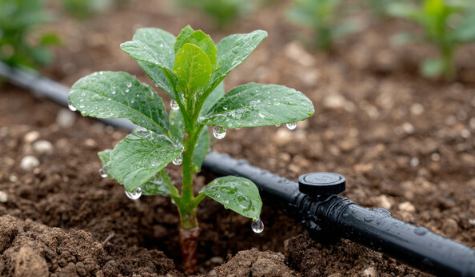
Water scarcity is one of the most pressing challenges facing agriculture today. With India consuming over 80% of its freshwater resources for farming alone, the pressure to grow more food with less water has never been greater. Enter drip irrigation — a precision water delivery system that is quietly transforming farms across the country, from small holdings in Karnataka to large agribusiness estates in Maharashtra.
Whether you’re a traditional farmer looking to cut costs or an investor exploring managed farmland opportunities, understanding drip irrigation is essential to understanding modern, profitable agriculture.
What Is Drip Irrigation?
Drip irrigation (also called trickle irrigation or micro-irrigation) is a method that delivers water directly to the root zone of plants through a network of pipes, tubes, and emitters. Rather than flooding entire fields or spraying water into the air, drip systems release water slowly and precisely — drop by drop.
This targeted approach ensures that every litre of water goes exactly where the plant needs it, reducing wastage and improving plant health simultaneously.
Key Components of a Drip Irrigation System
- Mainline pipes – carry water from the source
- Sub-main lines – distribute water across sections
- Lateral lines – run alongside plant rows
- Drip emitters/drippers – release water at controlled rates
- Filter units – prevent clogging
- Fertigation injectors – deliver fertilizers through the system
- Pressure regulators – maintain uniform water flow
Why Modern Farms Are Switching to Drip Irrigation
1. Dramatic Water Savings
Traditional flood irrigation wastes 50–70% of water to evaporation, runoff, and deep percolation. Drip systems use 30–50% less water than conventional methods. For crops like sugarcane, pomegranate, and grapes — all high water consumers — this saving is transformational.
2. Higher Crop Yields
Studies by the Indian Council of Agricultural Research (ICAR) show that drip-irrigated farms can see yield improvements of 20–50% across a wide range of crops. The reason? Plants receive consistent moisture at the root zone, reducing the stress cycles of drought and overwatering that stunt growth.
3. Reduced Labour Costs
Automated drip systems can be programmed to run at specific times, eliminating the need for daily manual irrigation. On managed farmlands, this directly reduces operational costs and improves predictability of farm management.
4. Efficient Use of Fertilizers (Fertigation)
Drip systems allow farmers to dissolve fertilizers directly into the water supply — a practice known as fertigation. This ensures nutrients reach roots efficiently, reducing fertilizer use by up to 30% while improving uptake. Less fertilizer also means lower soil contamination and better long-term soil health.
5. Weed and Pest Control
Because water is delivered only to crops (not the surrounding soil), weed germination between rows is significantly reduced. Drier inter-row spaces also create less favourable environments for certain fungal diseases and pests.
6. Suitable for Any Terrain
Drip systems work on flat land, sloped terrain, and even hilly areas — making them ideal for farms in regions like Coorg, the Nilgiris, and the Western Ghats where conventional irrigation is impractical.
Drip Irrigation and India’s Farming Future
India’s government has recognised drip irrigation as a cornerstone of sustainable agriculture. Under the Pradhan Mantri Krishi Sinchayee Yojana (PMKSY) and the Per Drop More Crop scheme, subsidies of up to 55–90% are available for farmers installing drip systems — with higher subsidies for small and marginal farmers.
States like Maharashtra, Karnataka, Andhra Pradesh, and Gujarat have been leaders in drip adoption. Karnataka alone has brought over 5 lakh hectares under micro-irrigation in recent years.
Drip Irrigation Across Key Crops
CropWater SavingYield IncreaseTomato40–50%30–40%Banana35–45%25–35%Sugarcane30–40%20–30%Pomegranate45–55%40–50%Coconut30–40%15–25%Coffee25–35%20–30%
Smart Farming: Drip Irrigation Meets Technology
Modern drip systems are no longer just pipes and drippers. Today’s precision agriculture integrates drip irrigation with:
- Soil moisture sensors that trigger irrigation only when needed
- Weather-based controllers that adjust watering schedules automatically
- IoT and app-based monitoring that lets farm managers track water usage remotely
- AI-driven analytics that predict crop water requirements based on growth stage and microclimate data
On professionally managed farmlands, these technologies work together to create farms that are not just efficient — but smart, scalable, and investor-ready.
Common Misconceptions About Drip Irrigation
“It’s too expensive.” Initial installation costs are real, but government subsidies dramatically reduce them. More importantly, the savings in water, fertilizer, and labour typically recover the investment within 2–3 seasons.
“It only works for big farms.” Drip systems are highly scalable. Micro-drip kits for kitchen gardens start under ₹2,000. For small farmers, even a 1-acre drip system can deliver measurable yield and income improvements.
“Maintenance is complicated.” Modern systems with good filtration require minimal maintenance. Flushing lines periodically and inspecting emitters every few weeks is usually sufficient.
The Role of Drip Irrigation in Managed Farmland Investment
For investors and NRIs exploring managed farmland in India, drip irrigation is not a luxury — it’s a baseline requirement. A farm without drip irrigation in 2024 is operating at a significant disadvantage in cost efficiency, yield, and sustainability.
Reputable managed farmland companies install drip infrastructure as part of their standard setup, ensuring that investor-owned plots receive scientifically calibrated irrigation throughout the growing season, regardless of rainfall patterns.
Conclusion
Drip irrigation is no longer a futuristic technology — it is the present reality of profitable, sustainable farming in India. It saves water, boosts yields, cuts costs, and integrates seamlessly with modern smart farming practices. Whether you are cultivating your own land or investing in managed farmland, understanding and embracing drip irrigation is one of the most impactful steps you can take toward agricultural success.
The farms of tomorrow are being built today — and they all have drip lines running through them.
Frequently Asked Questions
Q: What is drip irrigation?
A: It is a precision watering system that delivers water and nutrients directly to a plant’s root zone slowly and precisely through pipes, tubing, and emitters.
Q: How much water does drip irrigation save compared to traditional methods?
A: Drip irrigation uses 30% to 50% less water than conventional flood irrigation, which typically loses up to 70% of water to evaporation and runoff.
Q: Does drip irrigation improve crop yield?
A: Yes, studies by ICAR show crop yield increases of 20% to 50% because plants receive consistent, stress-free moisture at their roots.
Q: What is fertigation?
A: Fertigation is the process of applying water-soluble fertilizers directly through the drip system, reducing fertilizer usage by up to 30% while improving nutrient absorption.
Q: Are government subsidies available for drip irrigation in India?
A: Yes, under schemes like PMKSY (Per Drop More Crop), government subsidies ranging from 55% to 90% are available to help farmers install drip systems.
Q: How quickly can a farmer recover the cost of installing a drip system?
A: Thanks to government subsidies and savings in water, fertilizer, and labor, most farmers recover their investment within 2 to 3 growing seasons.