Sustainable Farming and the Future of Land Investment: Why Green is the New Gold
For decades, land has been considered one of the safest “hard assets” in an investment portfolio. However, as we move through 2026, the criteria for what makes land valuable have undergone a seismic shift. Traditional, high-input farming is no longer the benchmark for appreciation. Instead, sustainable farming and regenerative agriculture have emerged as the primary drivers of long-term capital growth and risk mitigation.
For the modern investor, the goal isn’t just to own acres; it’s to own a resilient, self-sustaining ecosystem.
1. Regenerative Agriculture: Transforming Soil into Capital
The most significant trend in 2026 is the transition from “sustaining” land to “regenerating” it. Regenerative agriculture focuses on restoring soil health, which directly impacts the land’s valuation.
- Soil Organic Matter (SOM): Higher SOM improves water retention and crop yields, making the land more resilient to the droughts and heatwaves that have become more frequent in recent years.
- Carbon Sequestration: With the expansion of carbon credit markets, healthy soil is now a secondary revenue stream. Farmland that acts as a carbon sink is worth significantly more than depleted soil.
- Yield Stability: Studies show that regenerative farms now yield 10–18% more consistently during extreme weather cycles compared to conventional farms.
2. Precision Agritech: The Efficiency Premium
Investment-grade farmland in 2026 is increasingly defined by its “tech-readiness.” Precision agriculture uses IoT sensors, AI-driven drones, and satellite imagery to optimize every square meter of soil.
As an investor, buying land that utilizes smart irrigation or automated nutrient management reduces operational overhead. Lower costs mean higher margins for passive income seekers. Digital traceability—knowing exactly how a crop was grown—also allows produce to be sold at a premium in global markets, further boosting the land’s earning potential.
3. Agroforestry and Diversified Income Streams
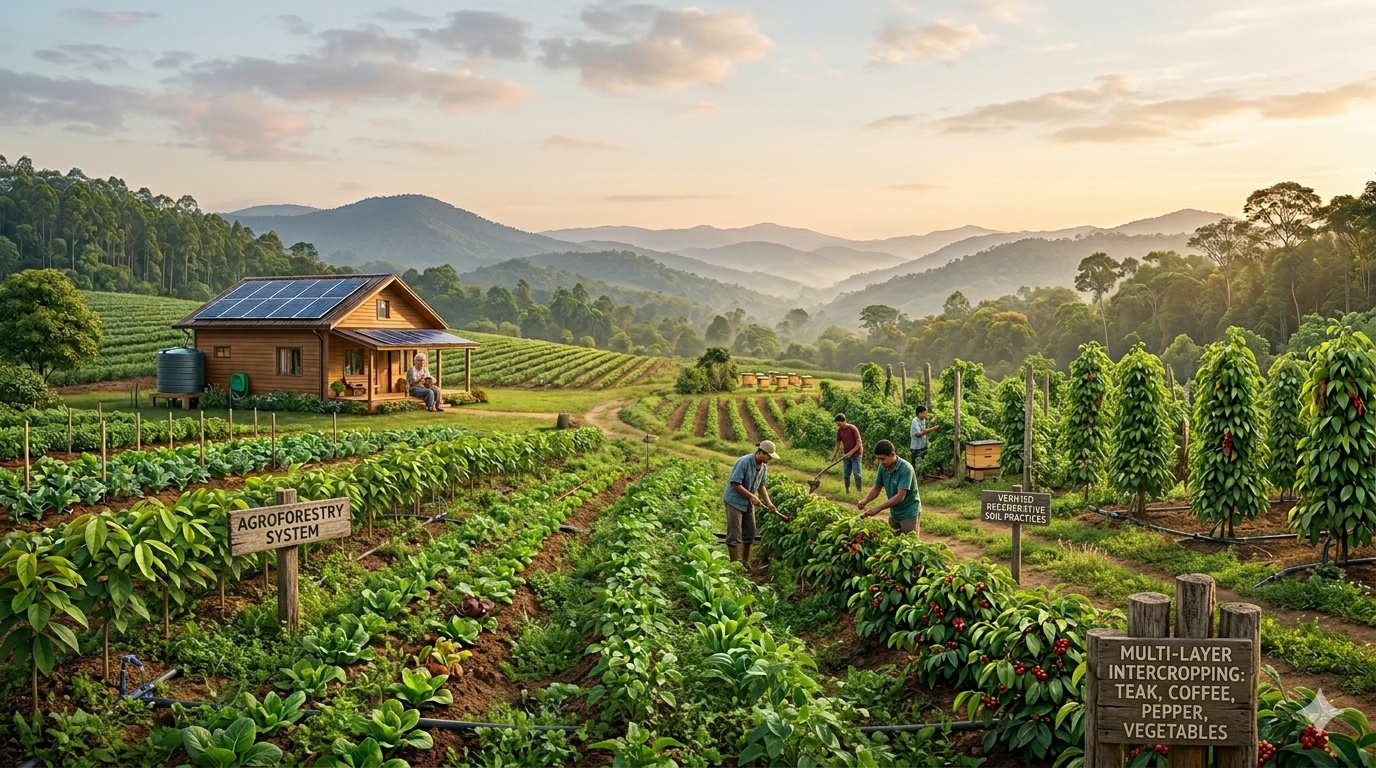
The “Scotland of India” (Coorg) and other premium agricultural zones have proven that agroforestry is the future of land investment. By integrating timber, fruit orchards, and shade-grown crops like coffee or pepper, investors create a “stacked” income model.
- Biodiversity Benefit: Diversified land is less susceptible to market crashes in a single commodity.
- Aesthetic Appreciation: Land that mimics a natural forest doesn’t just produce food; it has high resale value for the growing eco-tourism and “farmhouse living” markets.
4. ESG and the Institutional Shift
Environmental, Social, and Governance (ESG) factors are no longer optional. Global institutional investors are reallocating trillions into Natural Capital.
In 2026, over 80% of asset owners in South Asia and Europe have increased their allocations to sustainable land strategies. This institutional demand creates a “floor” for land prices; if your land meets high sustainability standards, it is essentially “future-proofed” against regulatory shifts and climate-related devaluation.
5. How to Identify a High-Potential Land Investment
If you are looking to enter the market this year, focus on these three indicators:
- Water Security: Prioritize land with established rainwater harvesting or smart-drip infrastructure.
- Verification Standards: Look for land that has verifiable soil health data or “Green Certifications.”
- Proximity to Infrastructure: Sustainable farms still need access to “Green Corridors” or markets that value organic and carbon-neutral produce.